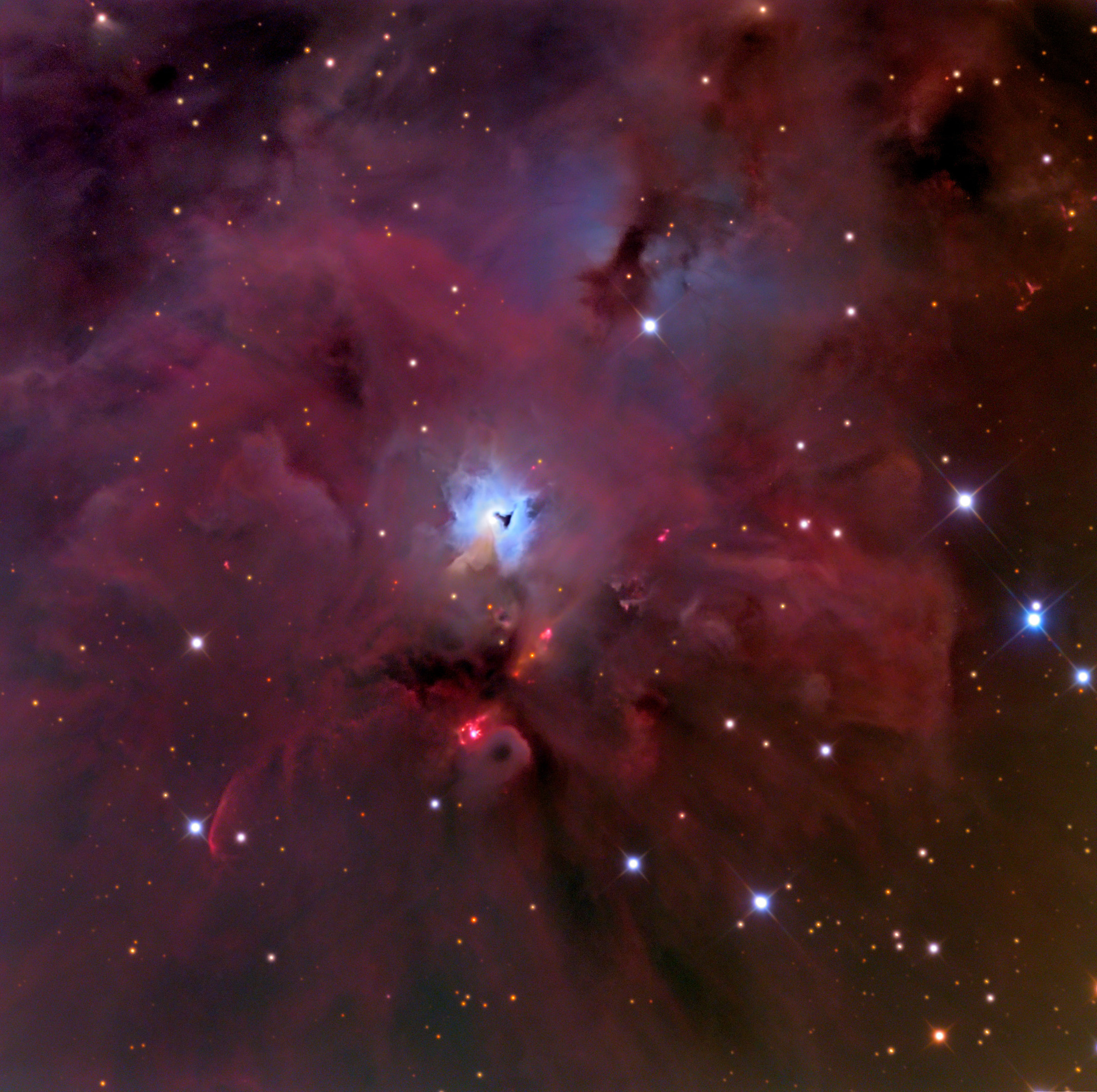
This is a photo of the bright blue reflection nebula, NGC 1999, and it lies south of the large star-forming Orion Nebula. NGC 1999's illumination is provided by the embedded variable star V380 Orionis. The nebula is marked with a dark sideways T-shape near center is this photo. This broad cosmic vista spans over 10 light-years. The dark shape was once assumed to be an obscuring dust cloud seen in silhouette against the bright reflection nebula. But it has been determined that the shape is likely the be a hole blown through the nebula itself by energetic young stars using infrared images. This region is filled with energetic young stars that produce jets and outflows that create luminous shock waves. The shock, Herbig-Haro (HH), appears bright red in this view that included HH1 and HH2 just below NGC 1999. The objects were named for astronomers George Herbig and Guillermo Haro. The stellar jets and outflows push through the surrounding material at speeds of hundreds of kilometers per second.

No comments:
Post a Comment