Thursday, March 31, 2011
APOD 4.1
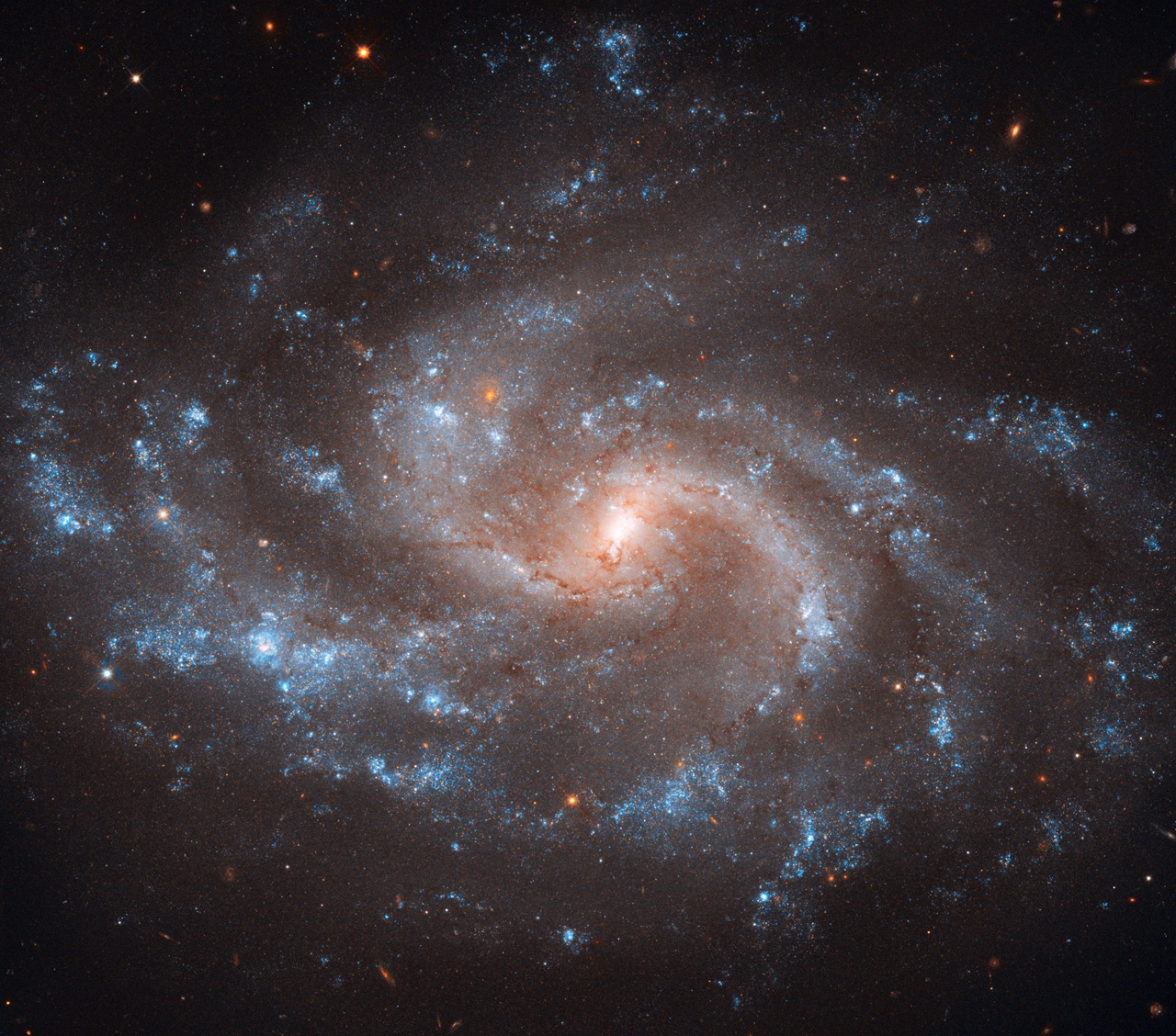
This is a photo of NGC 5584 and it is more than 50,000 light-years across and lies 72 million light-years away toward the constellation Virgo. This is an island universe and it has winding spiral arms that are filled with luminous young star clusters and dark dust lanes. It hosts some 250 Cepheid variable stars and a recent Type Ia supernova explosion, key objects for astronomical determinations. NGC 5584 is one of 8 galaxies used in a new study that includes additional Hubble Space Telescope observations to improve the measurement of Hubble's Constant (the expansion rate of the Universe). The results of the study allude to the theory that dark energy really is responsible for accelerating the expansion of the Universe, restricting models that try to explain the observed acceleration without the dark energy.
Wednesday, March 30, 2011
Quarter 3, Observation 5
I looked at the sky this morning, March 30th, around 6 A.M. when I woke up. I saw the Moon from my front yard and it was in the phase of a waning crescent. It was clear that this is one of the last couple of days before it turns in to a new moon because only a very slight portion of the crescent was still illuminated and visible. The rest of the sky was completely dark and the sky was relatively clear but I couldn't locate any stars or constellations.
Friday, March 18, 2011
APOD 3.8
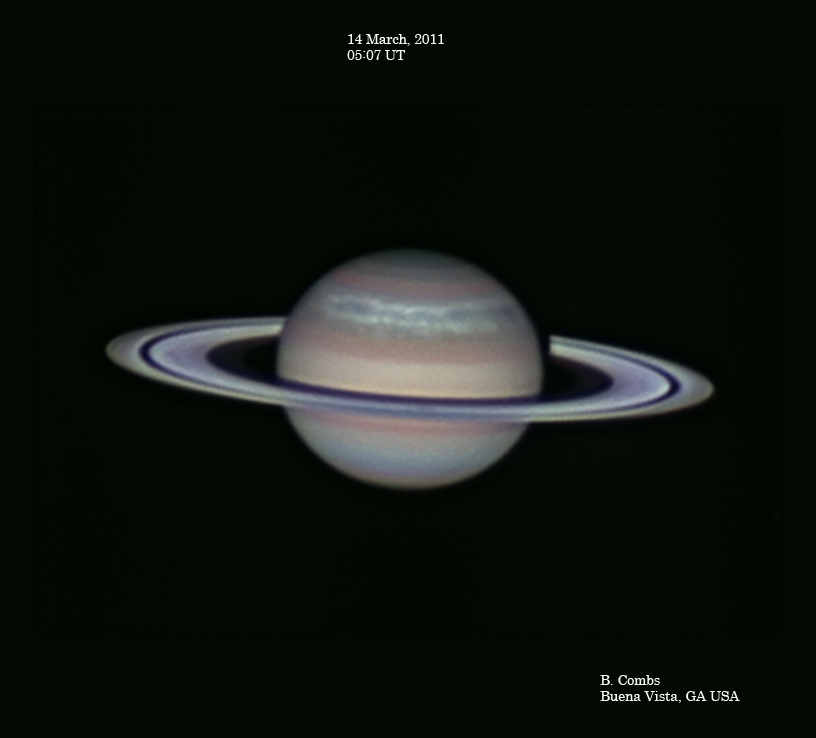
Towards the end of last year, a bright and new storm erupted in Saturn's northern hemisphere. It was nicknamed "the Serpent Storm" and the northern hemisphere disturbance is still going and now circles far around the planet. The Saturn-orbiting Cassini spacecraft has a great view of the storm. But this photo was taken on land in Buena Vista, Georgia. It is visible on land because the storm shows enough contrast with the banded cloud tops. The bright storm was first spotted in early December 2010 by amateur astronomers. The ringed gas giant rose in predawn skies and the astronomers continue to monitor the storm's progress.
Friday, March 4, 2011
APOD 3.7
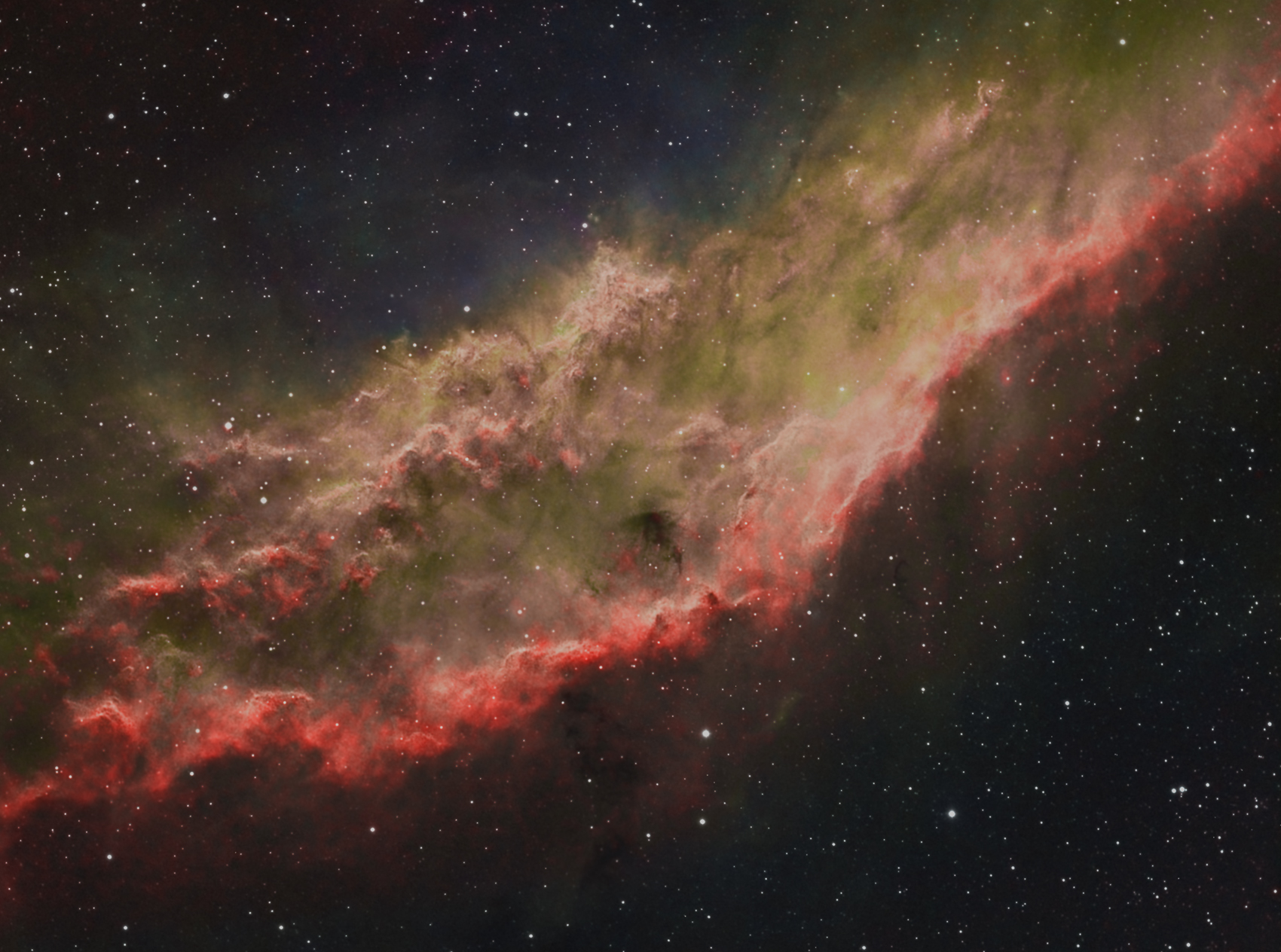
This cosmic cloud looks very similar to the outline of California. It is drifting through the Orion Arm of the spiral Milky Way Galaxy. The Sun lies within the Milky Way's Orion Arm and is only about 1,500 light-years from the California Nebula, also known as NGC 1499. The classic emission nebula is around 100 light-years long. The most prominent glow of the California Nebula is the red light characteristic of hydrogen atoms recombining with long lost electrons, ionized by energetic starlight. But in this photo, hydrogen in colored green while sulfur is mapped to red and oxygen to blue.The bright, hot, bluish Xi Persei, is the star most likely providing the energetic starlight that ionized much of the nebular gas. The California Nebula can be spotted with a wide-field telescope under a dark sky toward the constellation of Perseus, not far from the Pleiades.
Tuesday, March 1, 2011
APOD 3.6
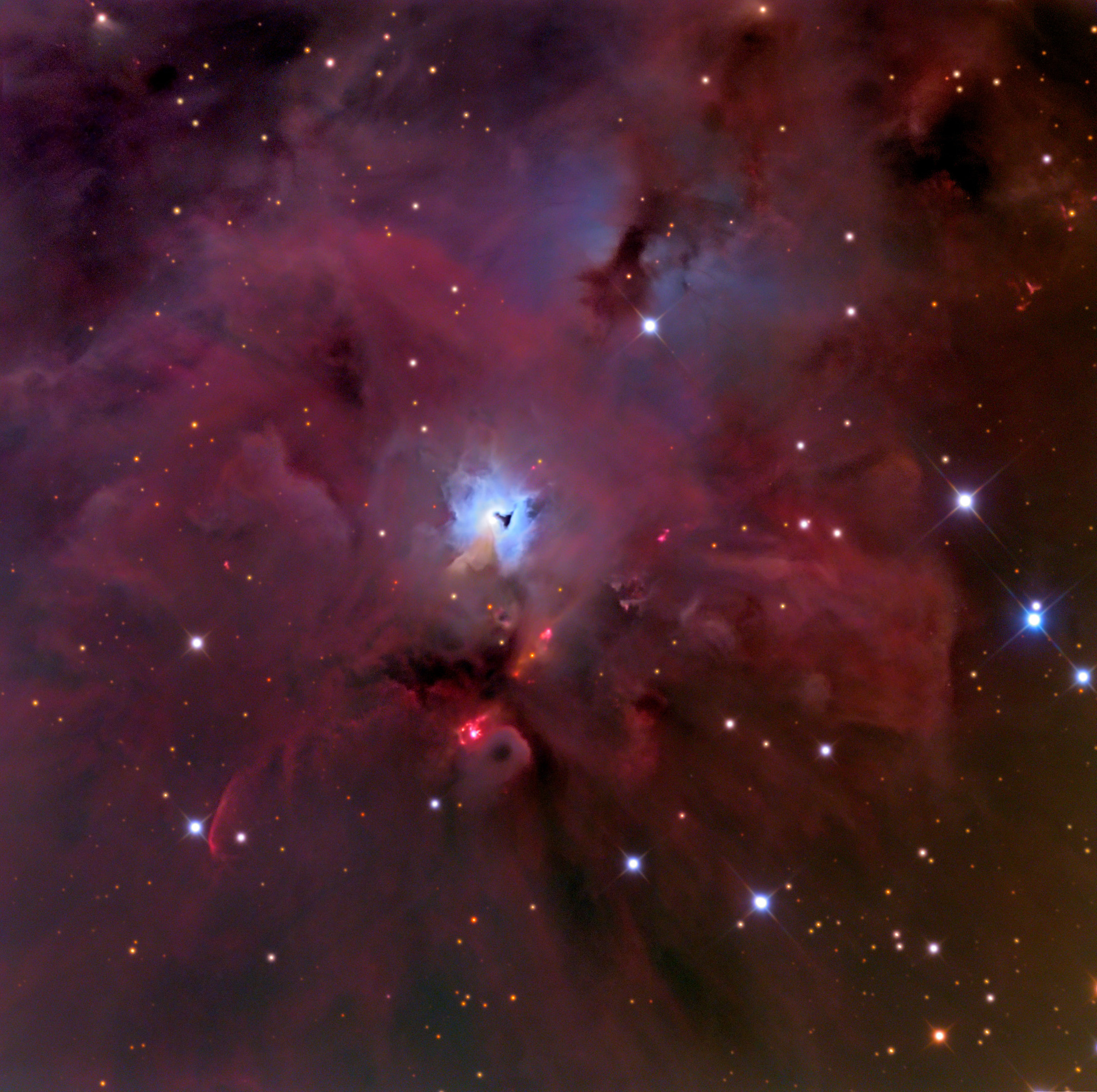
This is a photo of the bright blue reflection nebula, NGC 1999, and it lies south of the large star-forming Orion Nebula. NGC 1999's illumination is provided by the embedded variable star V380 Orionis. The nebula is marked with a dark sideways T-shape near center is this photo. This broad cosmic vista spans over 10 light-years. The dark shape was once assumed to be an obscuring dust cloud seen in silhouette against the bright reflection nebula. But it has been determined that the shape is likely the be a hole blown through the nebula itself by energetic young stars using infrared images. This region is filled with energetic young stars that produce jets and outflows that create luminous shock waves. The shock, Herbig-Haro (HH), appears bright red in this view that included HH1 and HH2 just below NGC 1999. The objects were named for astronomers George Herbig and Guillermo Haro. The stellar jets and outflows push through the surrounding material at speeds of hundreds of kilometers per second.
Subscribe to:
Comments (Atom)