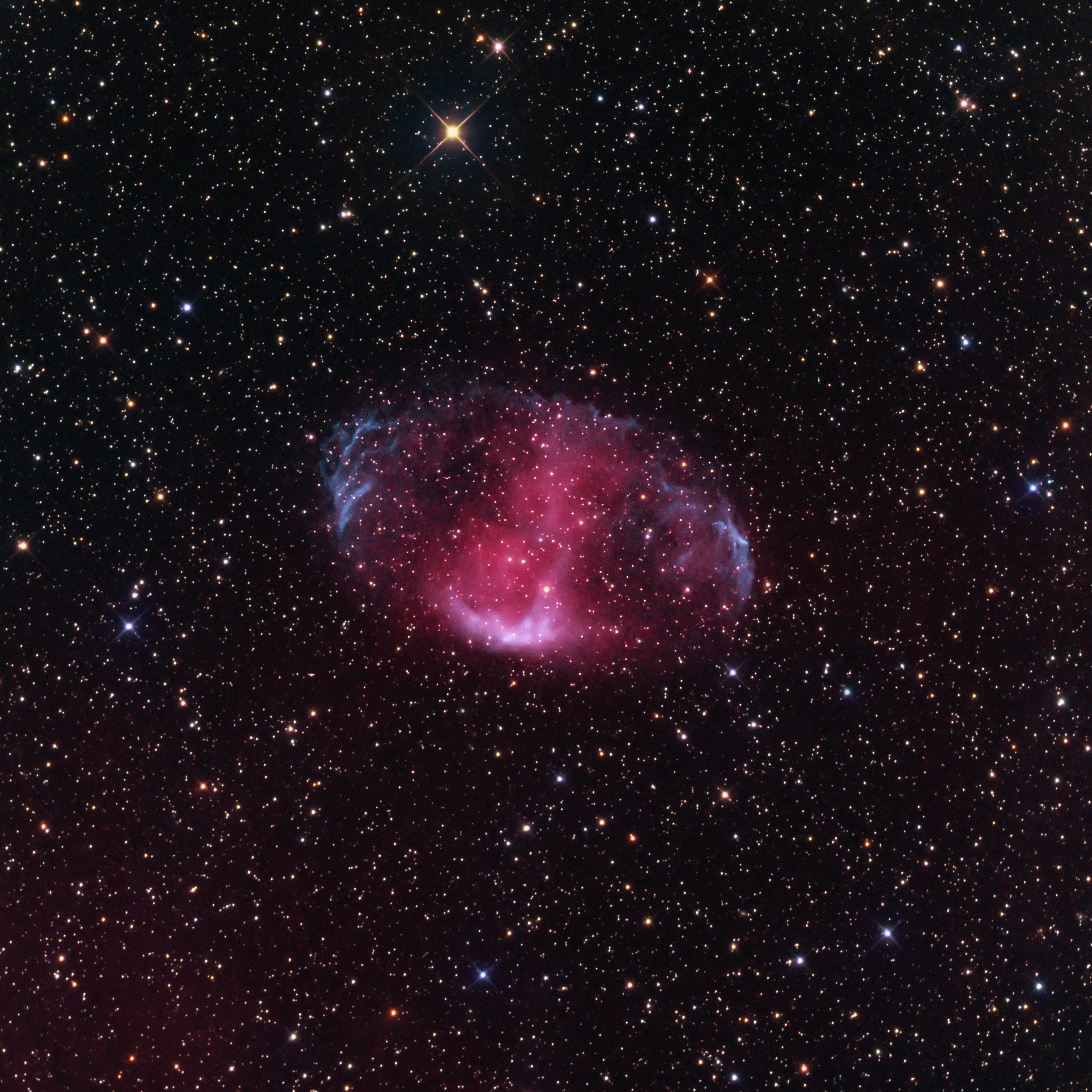
Pictured above is the symmetric planetary nebula called MWP1 and it lies some 4,500 light-years away in the northern constellation Cygnus. It is one of the largest planetary nebulae cataloged and it spans about 15 light-years. It can be determined from its expansion rate that it has an age of 150 thousand years which is a very short time compared to the 10 billion year life of a sun-like star. But these planetary nebulae represent a very short final phase in the process of stellar evolution. It is when the nebula's central star removes its outer layers to become a hot white dwarf. Planetary nebulae usually only last for 10 to 20 thousand years. Consequently, ancients such as MWP1 offer a challenge for astronomers studying the evolution of its central star.

No comments:
Post a Comment