Thursday, October 28, 2010
APOD 2.1

Friday, October 22, 2010
APOD 1.8

Pictured above is a solar prominence. This photo was captured by the Sun-orbiting SOHO satellite earlier this year. This photo was taken during an early stage of the eruption which has quickly become one of the biggest ever on record! The enormity of the prominence can be clearly seen from the photo (the Earth would fit inside!). A solar prominence is defined as a thin cloud of solar gas held just above the surface by the Sun's magnetic field. A quiescent prominence usually lasts for about a month but an eruptive prominence such as the one photographed above may erupt within hours into a Coronal Mass Ejection (CME) which expels hot gas into the Solar System. Although prominences are very hot, they usually appear dark when viewed against the Sun because they are still a little bit cooler than the surface of the Sun. More large eruptive prominences are expected as our Sun evolves toward Solar maximum over the next three years.
Tuesday, October 19, 2010
APOD 1.7
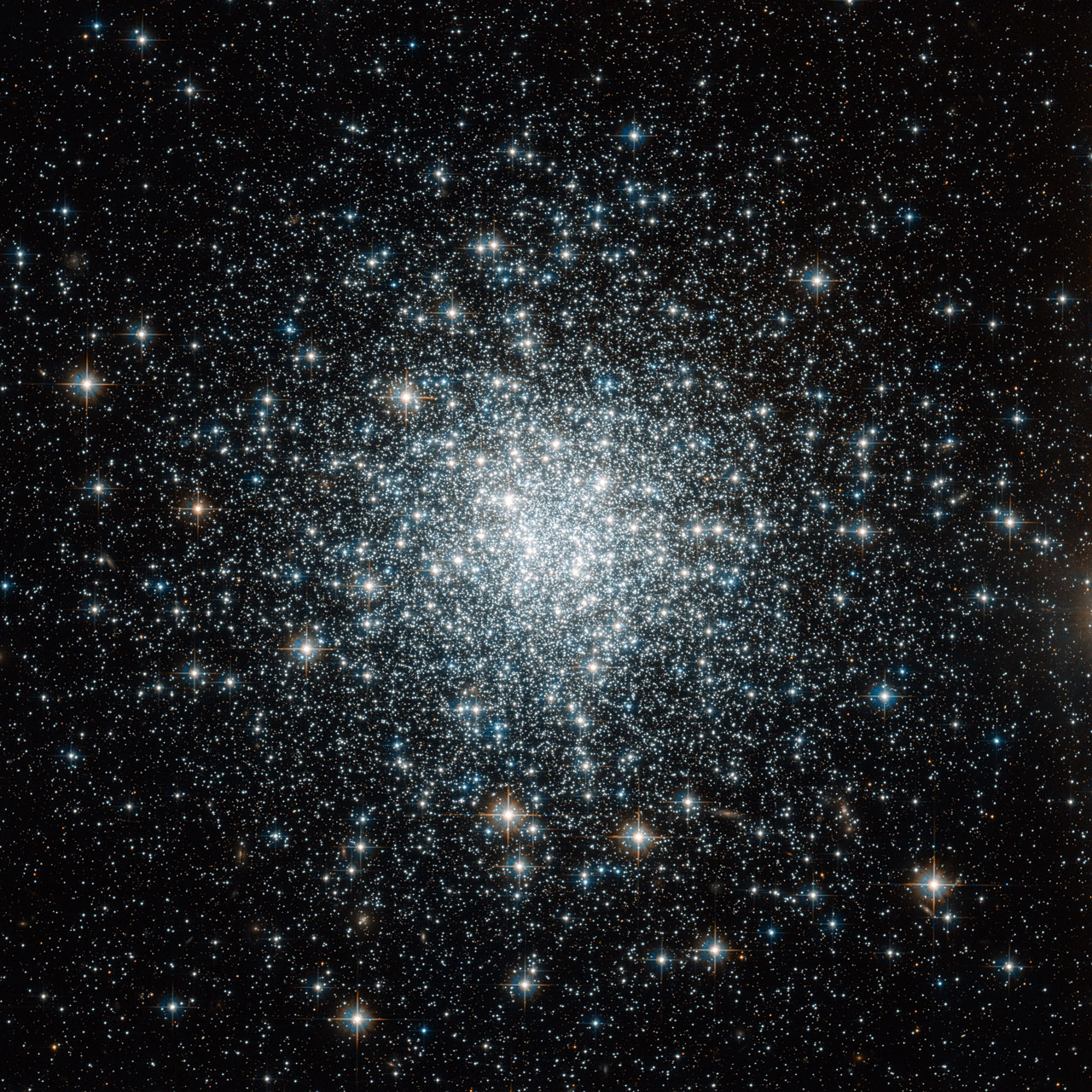
Globular star clusters, ancient spherical groupings of several thousand stars, roam the halo of our Milky Way Galaxy. These globular star clusters are gravitationally bound and older than the stars of the galactic disk. Incredibly, measurements of globular cluster ages appear to be even older than the stars in the Universe. Accurate cluster distance determinations gice us a rung on the astronomical distance ladder. Pictured above is the globular star cluster NGC 6934 and it lies about 5,000 light-years away in the constellation Delphinus. Because of this large distance, we know that this image from Hubble's Advanced Camera for Surveys spans about 50 light-years. Such cluster stars are estimated to be some 10 billion years old.
Sunday, October 17, 2010
Quarter One Astronomer Biography
Quarter One Astronomer
James Bradley was born in Sherborne, Gloucestershire in March of 1693. Bradley was the third son of William Bradley and Jane Pound. James’s parents had always intended for him to have a career in the church; but his uncle had other plans for him. His uncle was the Reverend James Pound, who just so happened to be one of the most promising amateur astronomers of his time. While James’s father’s income was limited, his education was paid for in large part by his uncle. Not only did Bradley’s uncle facilitate his education, he also was one of the main forces driving Bradley’s love of astronomy. Bradley received an education at Northleach Grammar School and at Balliol College , Oxford Balliol College Oxford
In 1719, Bradley took orders when he was given his living at Bridstow. Meanwhile, he never ceased his studies in the field of astronomy under the instruction of his uncle. In 1718 he received the honor of being elected as a fellow of the Royal Society. At only 28 years old, he became Savilian professor of astronomy at Oxford
Bradley lived in a time when astronomers were largely on their own when it came to repairing or modifying their equipment. Amazingly, in 1722, Bradley measured the diameter of Venus with a telescope that was over 212 feet in length.
Bradley was very lucky in that he had many connections in the world of astronomy such as his uncle and Samuel Molyneux. Molyneux had an observatory at Kew near London
Bradley’s work on aberration lead to his further discoveries. Namely he discovered nutation, the oscillation of the earth’s axis caused by the changing direction of the gravitational pull of the moon on the equatorial bulge. Bradley asserted that nutation must result from the fact that the moon is sometimes above and sometimes below the ecliptic. Therefore, it should have the periodicity of the lunar node. The period from 1727 to 1747, a full cycle of the motion of the moon’s nodes, was covered by his observations.
At Greenwich
Friday, October 8, 2010
APOD 1.6

Friday, October 1, 2010
APOD 1.5
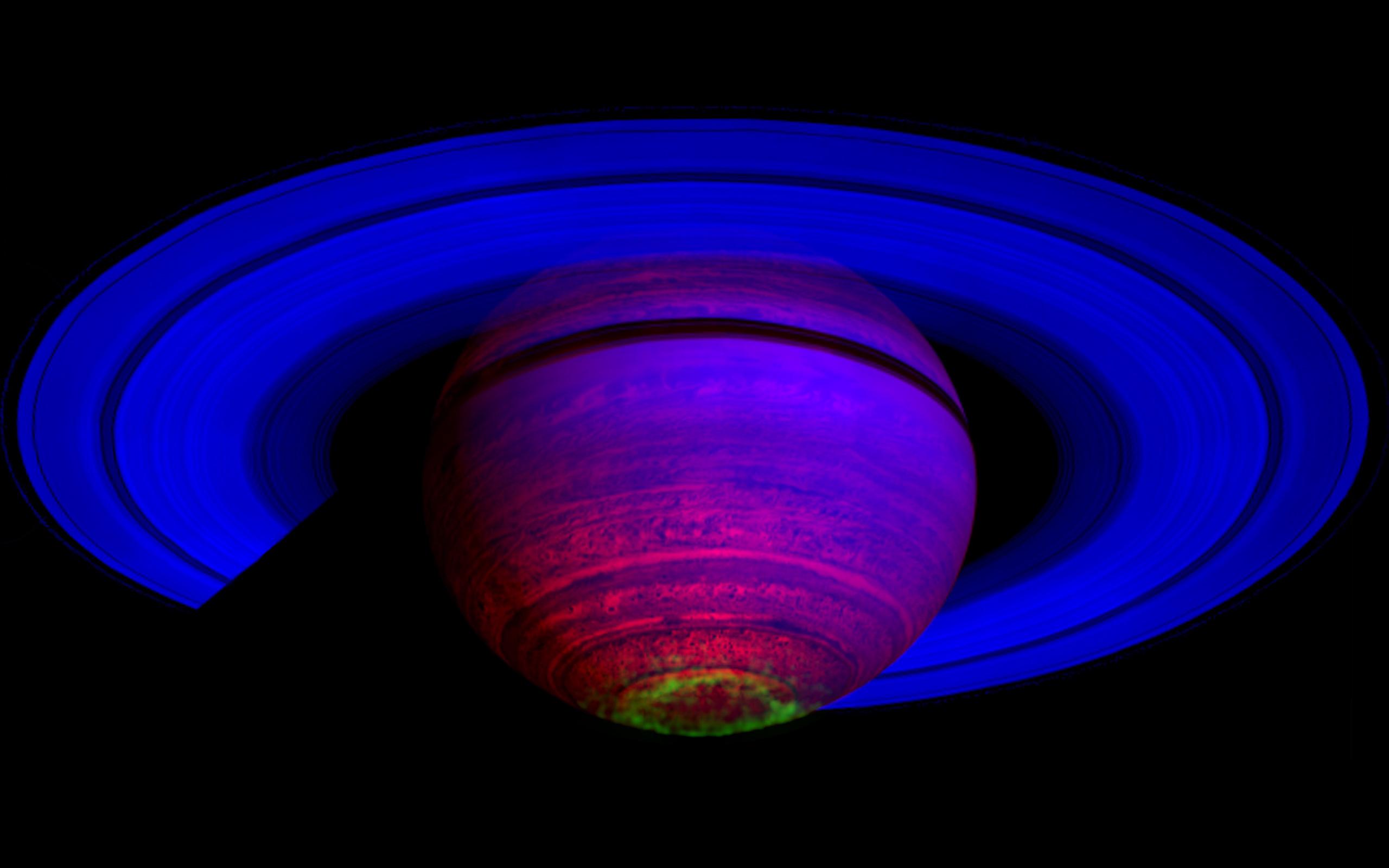
This is a photo of an aurora on Saturn. Scientists have been tirelessly working to try to find out what causes these auroras on Saturn. They have been looking through hundreds of infrared images that were taken by the Cassini spacecraft and trying to compile enough photos of the auroras to make a movie. Some of these movies have shown that these auroras on Saturn can change with the angle of the Sun and as the planet rotates. They have also found that some changes in the aurora are related to waves in the planet's magnetosphere which is most likely a result of Saturn's moons. This particular photo was taken in 2007 and is falsely colored. Nonetheless, it shows Saturn in three bands of infrared light. The rings are reflecting blue sunlight while the planet is glowing in a red lower energy. The green represents the band of southern aurora.
Astronomer Research Sources (Quarter 1)
Dictionary of Scientific Biography. C. Gillispie, editor. Charles Scribner's Son, publisher. 1981
"James Bradley." Encyclopedia of World Biography. 2nd ed. Vol. 2. Detroit: Gale, 2004. 482-483. Gale Virtual Reference Library. Web. 1 Oct. 2010.
"James Bradley." Encyclopedia of World Biography. 2nd ed. Vol. 2. Detroit: Gale, 2004. 482-483. Gale Virtual Reference Library. Web. 1 Oct. 2010.
Subscribe to:
Comments (Atom)