Friday, May 20, 2011
Weekly hour log for zooniverse 6
On Monday, 5/16, I worked on the Galaxy Zoo: Supernovae Project on zooniverse in class. On Wednesday, 5/18, I worked on the Galaxy Zoo: Supernovae Project again at home for an hour. The on Friday, 5/20, I worked on the Old Weather Project for half the class period. So I spent a total of 2.5 hours on zooniverse this week.

APOD 4.8

This is a photo of a dusty island universe and is one of the brightest spiral galaxies in planet Earth's sky. NGC 253 is only 13 million light-years away, and is the largest member of the Sculptor Group of galaxies and is neighbor to our own local galaxy group. This is a five frame mosaic based on data assembled from the Hubble Legacy Archive. Beginning on the left near the galaxy's core, the image follows dust filaments, interstellar gas clouds, and even individual stars toward the galaxy's edge at the right. The vista spans nearly 50,000 light-years. The frame at the far right has been compressed slightly to bring into view an interacting pair of background galaxies. Designated a starburst galaxy because of its "frantic" star forming activity, NGC 253 features tendrils of dust rising from as galactic disk laced with young star forming regions. NGC 253 is also known to be a strong source of high-energy x-rays and gamma rays, likelydue to massive black holes near the galaxy's center.
Tuesday, May 17, 2011
Quarter 4 Astronomy Biography
"Grote Reber." Encyclopædia Britannica. Encyclopædia Britannica. Encyclopædia Britannica, 2011. 17 May. 2011.
Quarter Four Astronomy Biography
Grote Reber was born on December 22nd, 1911 in Chicago, Illinois. His father was Schuyler Colefax Reber and he owned a canning factory. His mother was Harriet Grote Reber and he had a younger brother named Schuyler Reber. His mother was a school teacher before marrying and she taught Edwin Hubble 7th and 8th grade science. Grote Reber attended Wheaton High School in Wheaton, Illinois. He then went to the BS Electrical Engineering University and the Illinois Institute of Technology. He graduated in 1933 with a degree in electrical engineering.
He was an amateur radio operator and worked for many radio manufacturers in Chicago from 1933 to 1947. He operated a ham radio station in his spare time. He learned of Karl Jansky’s work in 1933 regarding his discovery of radio waves from the Galaxy. This prompted him to teach himself astronomy after deciding this was the field he wanted to work in. He applied to Bell Labs, where Jansky was working, but this was during the peak of the Great Depression and there were no jobs available. In 1937 he constructed the world’s first radio telescope. It was made mostly out of sheet metal and was a 31-ft parabolic transit dish powered by an extension cord to his back yard. Until the end of World War II, he remained the world’s only radio astronomer. In 1938, his device picked up radio emissions from the Milky Way, which confirmed Jansky’s discovery. Reber had difficulty having his findings published because astronomers at the time knew too little about radio and radio engineers knew little about astronomy. His papers were finally published in Astrophysical Journal only after several, better educated, astronomers had visited his dish in Wheaton, Illinois. Reber refused a research appointment from Yerkes.
He then focused on making a radiofrequency sky map. He conducted the first thorough survey of radio waves across the sky and organized his data in maps showing the radio radiation of the Milky Way. He completed this in 1941 and extended it in 1943. In 1944, he became the first to detect radio emissions from the Andromeda galaxy and the sun. As his reputation grew, Reber became a professional scientist when he was hired at the National Bureau of Standards (now the National Institute of Standards of Technology) in 1947, to manage the agency’s first radio telescope. He wasn’t fond of the bureaucracy and quit within a few years. He ended up moving to Hawaii where he designed and built a rotating antenna to study the ionosphere. In the 1950s, he turned his focus to cosmic radio waves at very low frequencies, which can only penetrate the Earth’s ionosphere in certain areas and times of low solar activity. One area where these waves can reach the Earth is the Tasmanian region of Australia, so Reber relocated and continued his studies there until his death, with generally unrestricted grants from the Research Corporation. The standard theory of radio emissions from space was that they were due to black-body radiation, light (of which radio is a non-visible form) that is given off by all hot bodies. According to this theory, it would be expected that there would be considerably more high-energy light than low-energy, due to the presence of stars and other hot bodies. Reber demonstrated that the reverse was true, and that there was a considerable amount of low-energy radio signal. It was not until the 1950s that synchrotron radiation was offered as an explanation for these measurements. Reber sold his telescope to the National Bureau of Standards, and it was built on a turntable at their field station in Sterling, Virginia. Eventually the telescope made its way to NRAO in Green Bank, West Virginia. Reber supervised its reconstruction at that site and he also helped with a reconstruction of Jansky’s original telescope. He also conducted research in archeology, botany, electronics, and meteorology, and designed his own energy-efficient home and electric car. He died on December 20th, 2002 in Tasmania, Australia.
Monday, May 16, 2011
Weekly hour log for zooniverse 5
On Wednesday, 5/11, I worked on the Old Weather Project for an hour at home. On Thursday, 5/12, I worked on the Old Weather Project again at home for an hour. On Friday, 5/13, I worked on the Moon Zoo Project for the last half of the class period. So I spent a total of 2.5 hours on zooniverse this week.
Quarter 4 Astro Bio Sources
"Grote Reber." National Radio Astronomy Observatory (NRAO): Look Deeper. Web. 13 May 2011. <http://www.nrao.edu/whatisra/hist_reber.shtml>.
"Grote Reber." NNDB: Tracking the Entire World. Soylent Communications. Web. 13 May 2011. <http://www.nndb.com/people/090/000172571/>.
Dieckhoff, Kerby. "Grote Reber." Angelfire: Welcome to Angelfire. Web. 13 May 2011. <http://www.angelfire.com/scifi/concordiasci/reber/reber.html>.
"The Bruce Medalists: Grote Reber." SSU Department of Physics & Astronomy - Home. The Bruce Medalists. Web. 13 May 2011. <http://www.phys-astro.sonoma.edu/brucemedalists/reber/index.html>.
APOD 4.7
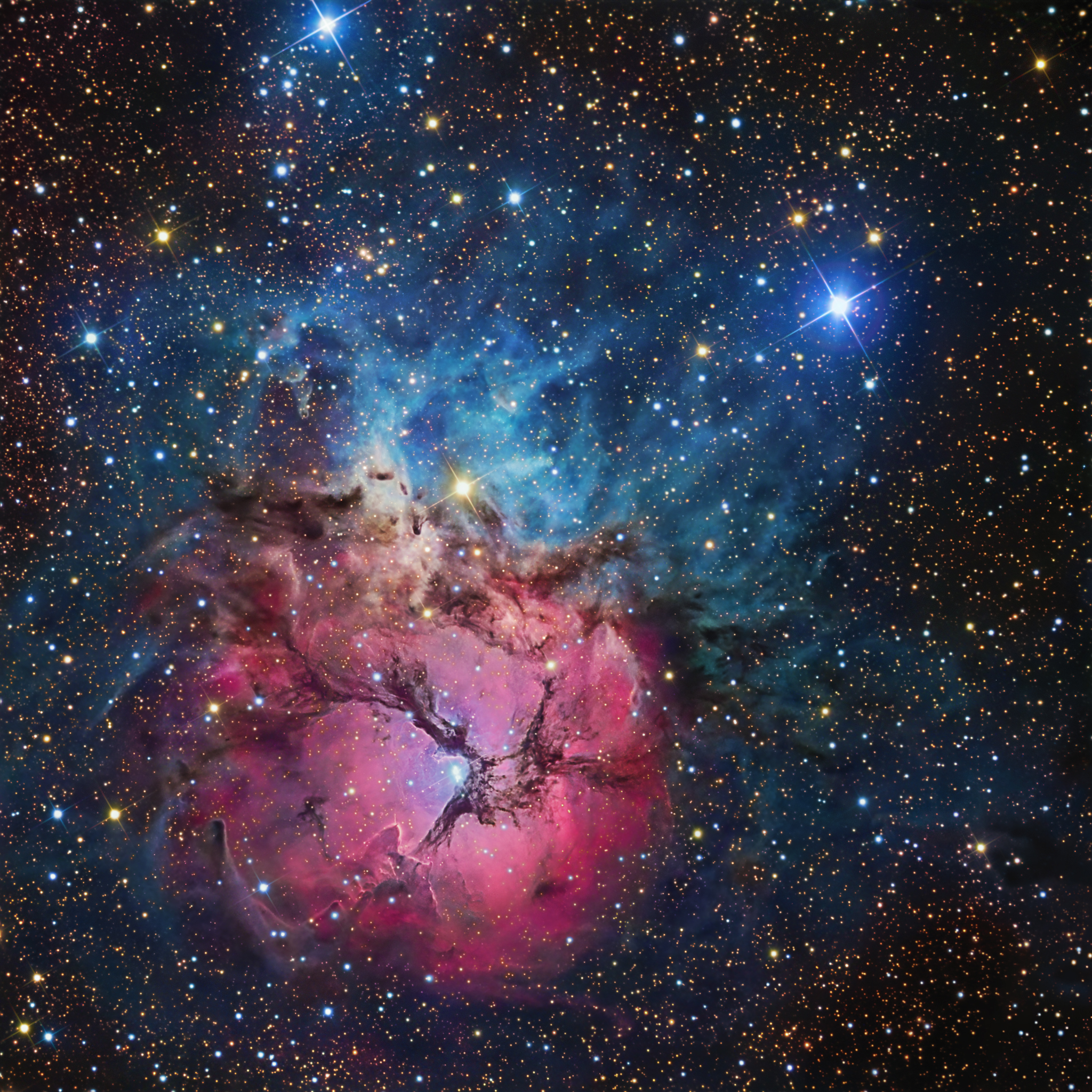
The Trifid Nebula is a cosmic study in colorful contrasts. It is also known as M20 and it lies about 5,000 light-years away toward the nebula rich constellation Sagittarius. A star forming region in the plane of our galaxy, the Trifid illustrates three different types of astronomical nebulae: red emission nebulae (dominated by light emitted by hydrogen atoms), blue reflection nebulae (produced by dust reflecting starlight), and dark nebulae (where dense dust clouds appear in silhouette). The bright red emission region, roughly separated into three party by obscuring, dark dust lanes, lends the Trifid its name. The red emission is also juxtaposed with the telltale blue haze of reflection nebulae. Pillars and jets sculpted by newborn stars, below and left of the emission nebula’s center, appear in Hubble Space Telescope close-up images of the region. The Trifid Nebula is about 40 light-years across.
Friday, May 6, 2011
Weekly hour log for zooniverse 4
On Tuesday, 5/3, I worked on the Solar Stormwatch project in class. Then on Thursday, 5/5, I continued to work on the Solar Stormwatch project at home for an hour. Then on Friday, 5/5, I worked on the Boulder Wars project for the last half of the class period. So I spent a total of 2.5 hours on zooniverse this week.
APOD 4.6

Subscribe to:
Comments (Atom)