Friday, April 29, 2011
APOD 4.5
There has been speculation about whether or not there is a monster in IC 1396. It is known as the Elephant's Trunk Nebula and parts of the glowing gas and dust clouds of this star formation region may appear to take on an ominous form, some nearly human. The entire nebula might even look like a face of a monster. It is actually a bright young star too far from Earth to be dangerous. Energetic light from this star is eating away the dust of the dark cometary globule at the top right of the image. Jets and winds of particles emitted from this star are also pushing away ambient gas and dust. It is nearly 3,000 light-years distant and the IC 1396 complex is relatively faint and covers a region in the sky with an apparent width of more than 10 full moons. Recently, over 100 young stars have been discovered forming in the nebula.
Monday, April 25, 2011
APOD 4.4
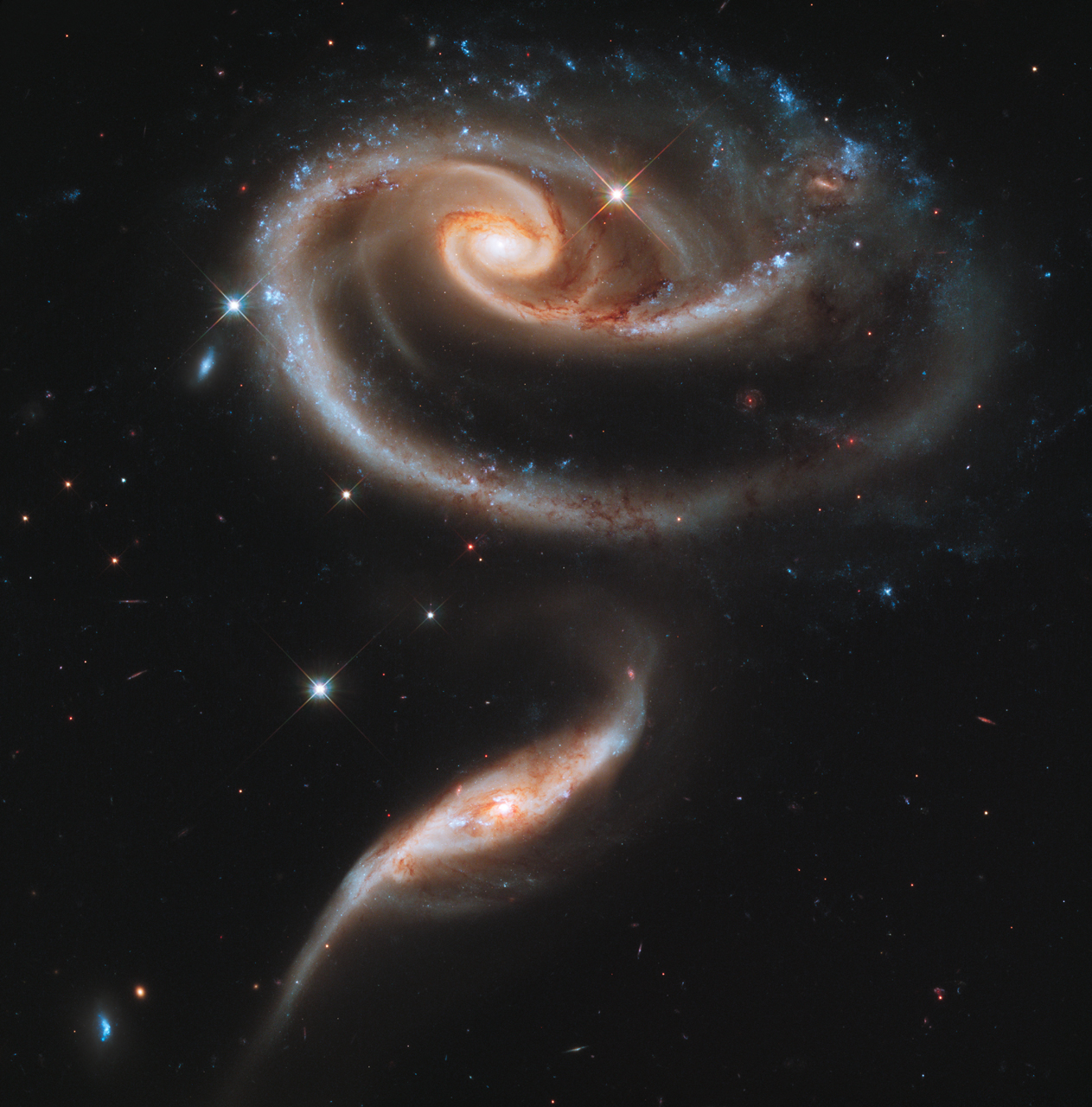
The spiky stars visible in the foreground of this cosmic image are within the Milky Way Galaxy. The two galaxies lie far beyond the Milky Way, at a distance of over 300 million light-years. Their distorted appearance is due to gravitational tides as the pair engage in close encounters. They are cataloged as Arp 273 (also as UGC 1810) and the galaxies do look peculiar but interacting galaxies are now understood to be common in the universe. The nearby large spiral Andromeda Galaxy is known to be some 2 million light-years away and approaching the Milky Way. Arp 273 may offer an analog of their far future encounter. Repeated galaxy encounters on a cosmic timescale can ultimately result in a merger into a single galaxy of stars. From our perspective, the bright cores of the Arp 273 galaxies are separated by only a little over 100,000 light-years.
Weekly hour log for Zooniverse 3
I worked on the Planet Hunters Project in class on Tuesday, 4/19. I worked on the Planet Hunters Project again at home for an hour on Thursday, 4/21. I spent a total of 2 hours this week on Zooniverse.
Tuesday, April 19, 2011
Weekly hour log for Zooniverse project 2
On Tuesday, 4/12, I spent the class period working on the Planet Hunters Project. On Thursday, 4.14, I spent the class period working on the Planet Hunters Project again. So this week I have a total of 2 hours.
Thursday, April 14, 2011
APOD 4.3
This photo depicts a "quiet" day on the Sun. But even during off days, the Sun's surface is a busy place. This photo is in ultraviolet light, and the relatively cool dark regions have temperatures of thousands of degrees Celsius.The bright area visible near the horizon is the large sunspot group AR 9169 from the last solar cycle. The bright glowing gas flowing around the sunspots has a temperature of over one million degrees Celsius. The reason for the high temperature is unknown but thought to be related to the rapidly changing magnetic field loops that channel solar plasma. Large sunspot group AR 9169 moved across the Sun during 2000 September and decayed in a few weeks.
Friday, April 8, 2011
Weekly hour log for Zooniverse Project
On Tuesday, 4/5 , I spent the period working on the Moon Zoo Project. On Thursday, 4/7, I spent the period working on the Moon Zoo Project as well. Then on Friday, 4/8, I spent half of the class working on Boulder Wars (after I finished the Constellation Quiz and did my APOD). So I completed a total of 2.5 hours this week.
APOD 4.2
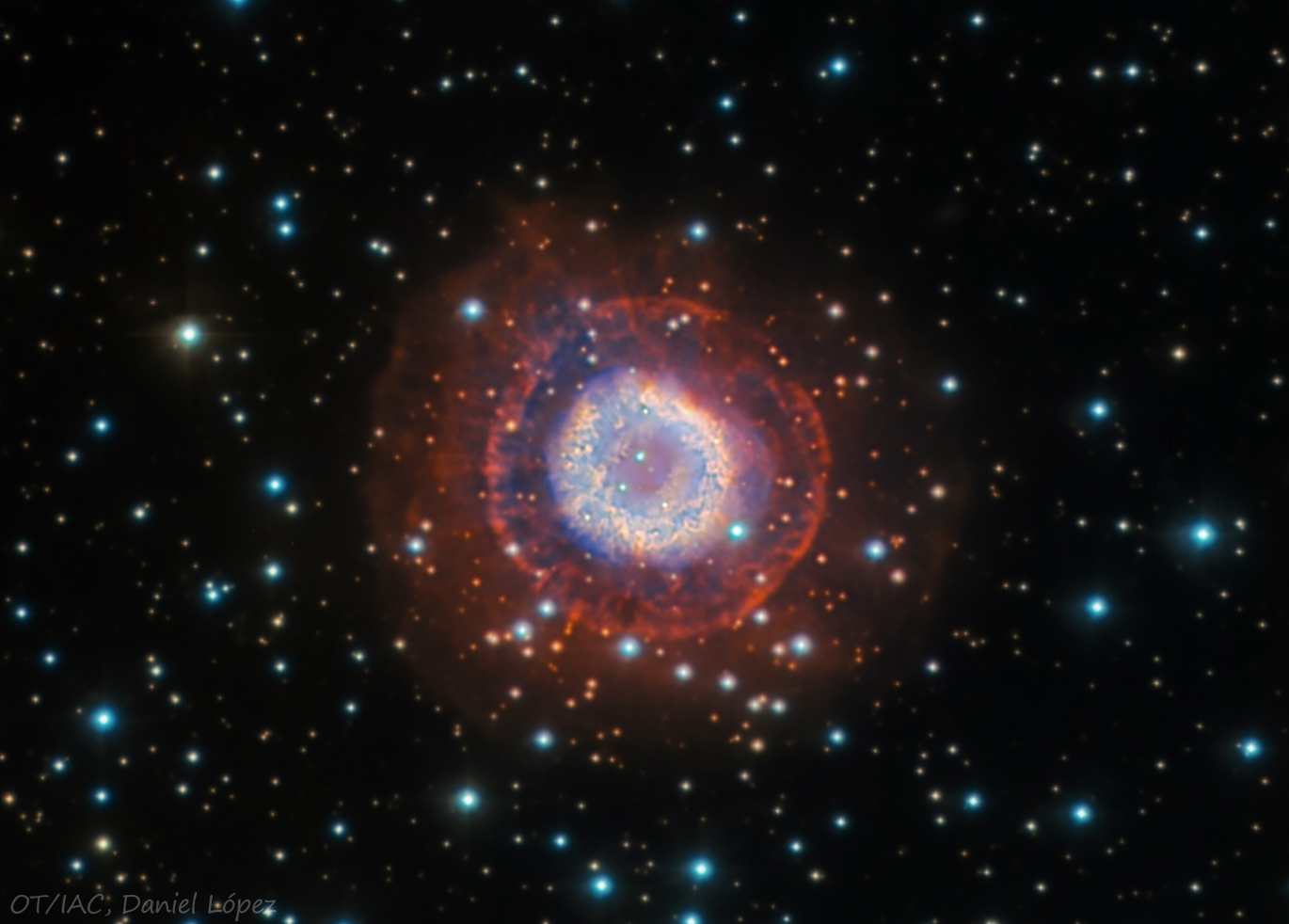
NGC 2438 is a planetary nebula, the gaseous shroud cast off by a dying sunlike star billions of years old whose central reservoir or hydrogen fuel has been exhausted. It is located about 3,000 light-years within the boundaries of the constellation Puppis. It also appears to lie on the outskirts of bright, relatively young open star cluster M46. But NGC 2438's central star is not only much older than the stars of M46, it moves through space at a different speed than the cluster stars. Distance estimates also place NGC 2438 closer than M46 and so the nebula appears in the foreground, only by chance along the line-of-sight to the young star cluster. This image of NGC 2438 shows a halo of glowing atomic gas over 4.5 light-years across, extending beyond the nebula's bright inner ring.
Subscribe to:
Comments (Atom)