This photo was taken by the robotic rover Opportunity on Mars. This photo shows yet another small crater discovered on Mars. It is called Intrepid Crater which is a 20-meter across impact basin a little larger than Nereus Crater that Opportunity discovered last year. This photo is said to be accurate in color but horizontally compressed to fit a wide angle panorama. Intrepid Crater was named after the lunar module Intrepid that carried Apollo 12 astronauts ot Earth's Moon 41 years ago last month. Peaks from the rim of large Endeavour Crater, visible on the horizon, lie beyond Intrepid Crater and past long patches of rusty. Scientists predict that Opportunity may reach Endeavour sometime next year if it can avoid ridged rocks and soft sand.
Friday, December 10, 2010
Thursday, December 2, 2010
APOD 2.5
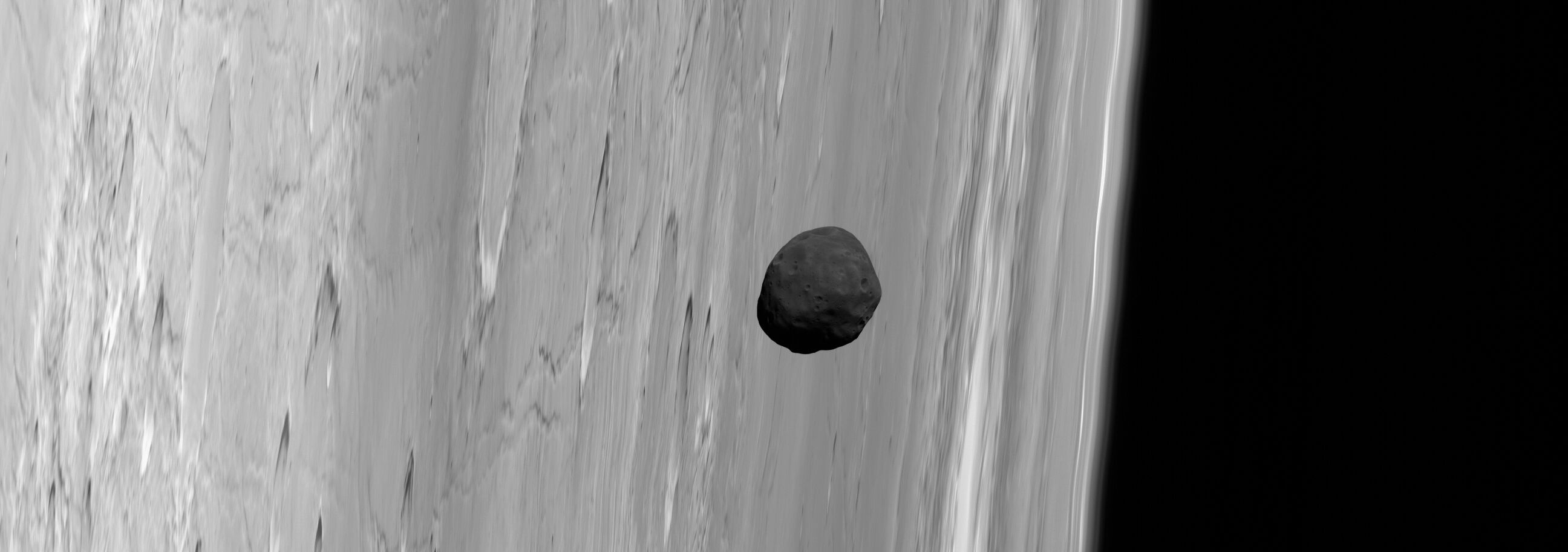
This is a photo of Phobos, the largest and innermost of Mars's two moons. It is the darkest moon in the Solar System. It has an unusual color and orbit allude to the possibility that it may be a captured asteroid composed of a mixture of ice and dark rock. This photo of Phobos was taken last month by the robot spacecraft Mars Express which is currently orbiting Mars. Phobos has many craters and is barren and its largest crater, Stickney, is located on the far side. Using photos like this one, it has been determined that Phobos is covered by about a meter of loose dust. Phobos has an unusual orbit because it is so close to Mars. From some places it appears to rise and set twice a day but from some places it is not visible at all. Phobos' orbit around Mars is chronically decaying and it is predicted to break-up with pieces falling on Mars in about 50 million years.
Subscribe to:
Comments (Atom)